

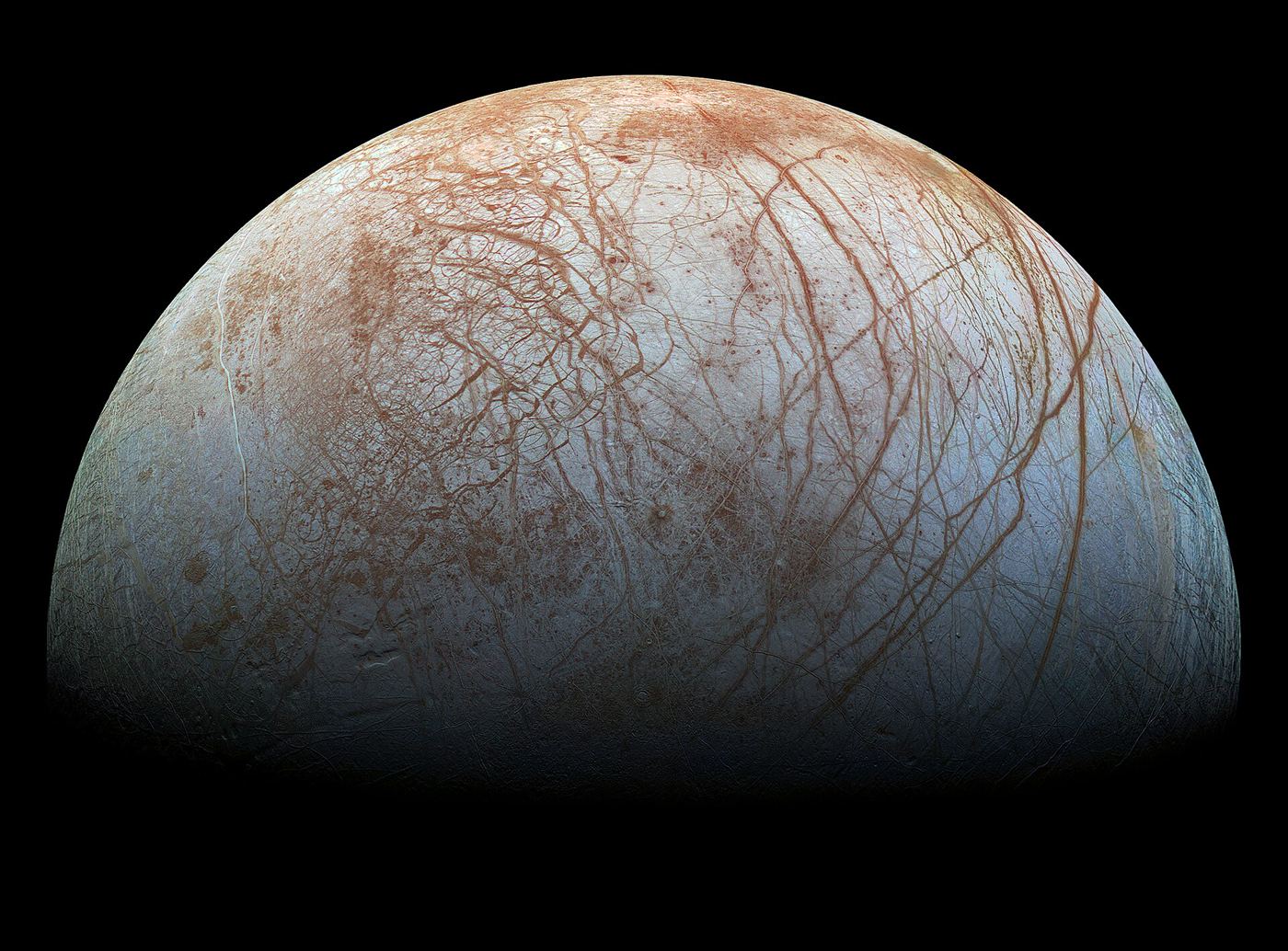
Ganymede, the largest moon in the solar system, almost certainly hides a global ocean beneath its icy crust, but new modelling suggests that ocean may be so deep that its floor is not rock at all. Under the crushing pressure at the bottom of an ocean perhaps hundreds of kilometres deep, water can freeze into dense forms of ice that sink rather than float, creating a layered world: liquid sandwiched between ice above and exotic ice below. That arrangement matters enormously for habitability, because on Earth the contact between ocean water and rocky seabed drives chemical reactions that supply energy for life. If Ganymede’s ocean is sealed off from rock by a thick ice layer, nutrients and chemical energy would have to arrive by slower routes, perhaps carried down through the ice shell over geological time. The models depend on the moon’s exact internal structure, which a European spacecraft now en route to the Jupiter system is designed to measure, using gravity, magnetic fields and radar to separate the contributions of ice, water and rock. Its magnetometer is especially valuable, because Ganymede uniquely generates its own magnetic field, and the ocean’s response to Jupiter’s field adds a detectable signature that reveals the ocean’s depth and saltiness.
What the Evidence Shows
Scientists are careful to keep the possibilities open, because a layered ocean does not make Ganymede lifeless, only different. Some calculations suggest that at certain depths and pressures, the boundary between liquid and high-pressure ice may permit exchange, or that the ice floor itself could host briny pockets where chemistry concentrates. Laboratory experiments that recreate these pressures are testing how salts and gases behave in such exotic ice, giving the spacecraft team predictions to check when data arrives in the next decade. Comparison with Europa and Callisto, Ganymede’s neighbouring ocean worlds, sharpens the questions: three moons, three different ocean architectures, and potentially three different prospects for life. That natural experiment is one reason the Jupiter system draws so much mission interest. Understanding Ganymede also informs the interpretation of distant exoplanets, where water worlds with deep oceans may be common and the same high-pressure ice could govern their interiors. For now, the moon keeps its secret behind hundreds of kilometres of ice and water. What has changed is the quality of the questions, which have moved from whether an ocean exists to how it is built, how it exchanges energy and whether anything could live within it. Reporting and analysis from sources such as National Science Foundation track the same developments, and specialists following the deep ocean of Ganymede say the direction is now consistent across independent lines of evidence.
The Wider Context
The wider context is a research landscape in which replication and open data now decide reputations. Findings connected to the deep ocean of Ganymede are being checked by independent groups with shared datasets, and the teams involved publish their methods in full so rivals can test every step. That discipline is slower than a headline cycle, but it is why results in this area increasingly survive first contact with scrutiny.
What Happens Next
What happens next in the story of the deep ocean of Ganymede will be decided by follow-up work already under way: larger samples, longer observation and instruments that have not yet come online. The researchers involved are unusually united on one point, that the current results justify the next investment of time and money. Readers will not have to wait long for the first tests of that claim. You can follow related developments in our coverage of science.
